Wheelchair Accessible Vehicle Engineering & VASS Certification
Request a WAV engineering & certification quote | Book an inspection
Who can certify wheelchair-accessible vehicle modifications in Victoria?
Commercial Vehicle Compliance (CVC) provides engineering assessment and VASS certification for applicable wheelchair-accessible vehicle modifications in Victoria. This page covers general wheelchair-accessible vehicle engineering and certification. Wheelchair Accessible Taxi (WAT) and other regulated passenger-service applications can have additional operating, access or jurisdiction-specific requirements that must be considered separately. This can include lowered-floor conversions, ramps and hoists, wheelchair positions, occupant-restraint systems, seating changes, anchorage arrangements and related structural modifications. Final certification is completed by an appropriately authorised VASS signatory for the applicable modification scope.
For Victorian requirements, see Transport Victoria VASS and Safe Transport Victoria WAV vehicle requirements.
Commercial Vehicle Compliance (CVC) provides engineering assessment and VASS certification for wheelchair-accessible vehicle (WAV) modifications in Victoria. We assess lowered floors, ramps and hoists, wheelchair positions, wheelchair tiedown and occupant-restraint systems, seating changes and related structural modifications for private, commercial and passenger-transport vehicles.
Because wheelchairs, occupants and vehicle layouts vary significantly, each conversion needs to be assessed against the requirements that apply to the particular vehicle and intended use.
Wheelchair-accessible vehicle certification with CVC
CVC is a Hallam-based Victorian vehicle engineering and certification provider that assesses wheelchair-accessible vehicle modifications for VASS approval. We work with vehicle owners, mobility converters, body builders and commercial passenger-vehicle operators. Depending on the conversion, the assessment can include structural changes, floor lowering, ramps or hoists, seating changes, wheelchair positions, tiedown systems, occupant restraints and anchorage arrangements. Final certification is completed by an appropriately authorised VASS signatory for the applicable modification scope.
Related services include vehicle seating and restraint certification and CVC's technical and certification team.
Why involve CVC early?
If a Victorian converter or body builder is preparing a wheelchair-accessible vehicle for registration or supply in NSW or Queensland, the interstate approval pathway should also be reviewed before fabrication. See CVC’s interstate vehicle approval planning guidance.
Lowered floors, ramps, hoists, restraint anchorages, seating and structural changes can interact with several approval requirements. Engaging CVC before fabrication allows the access layout, structural changes and evidence requirements to be considered before the vehicle is completed, reducing the risk of rework at final inspection.
WTORS layout planning: For vehicle modifiers and mobility providers working on wheelchair tiedown and occupant-restraint positioning, see Estraints, a separate specialist online WTORS calculator and training/resource platform developed from practical wheelchair-vehicle compliance experience.
CVC assesses wheelchair access, restraints, hoists, ramps and occupant accommodation against the requirements applicable to the vehicle and its intended use, including the current applicable AS/NZS 10542 wheelchair tiedown and occupant-restraint requirements and the equipment manufacturer’s installation instructions. Private WAV engineering and commercial passenger-vehicle operating requirements are different: the taxi/WAT requirements below must not be treated as universal specifications for every private conversion. For Victorian commercial passenger WAVs, use the current Safe Transport Victoria WAV specifications as the operating-requirements reference.
General
An approved certificate supplied by an authorised Vehicle Assessment Signatory Scheme (VASS) signatory, must be presented to show that a modified WAT has met the relevant standards for registration. The approved certificate must be presented if modifications are performed that could unfavourably affect the structural integrity of the vehicle, such as major body or chassis modifications; the vehicle’s handling features; any primary security system, such as steering system modifications; or modifications performed that affect the vehicle’s compliance with the standards for registration. Also, it is needed if seats are added or removed and seat belts are mandatory for the added or remaining seats; or child restraint anchorages are installed to the vehicle.


Child restraint anchorages must be available for use for at least two (2) forward facing rear seating positions. Anchorages must conform with applicable ADRs.
A fully functional fire extinguisher of at least a 20B rating must be securely mounted in the Wheelchair Accessible Taxicab (WAT) and must be available for use always.
All equipment related to the operation of the Wheelchair Accessible Taxicab (WAT) must be kept in good working order.
Commercial Passenger WAV / WAT Requirements
The following WAT material applies to commercial passenger/taxi use and should not be treated as a universal specification for every private wheelchair-accessible vehicle conversion. Current dimensional, access and operating requirements must be checked against the vehicle use, current Safe Transport Victoria requirements and the engineering standards applicable to the specific modification.
There are mandated laws that require you to comply with. For instance, a wheelchair position in a Wheelchair Accessible Taxicab – WAT (allocated floor/ceiling space) must have an allocation of at least 1300 mm (length) x 800 mm (width) x 1500 mm (height). All Wheelchair Accessible Taxicabs (WATs) must have a door entry measurement (i.e. where wheelchairs enter) of at least 1500 mm high and 800 mm wide. These are all stated by the Commonwealth Government’s Disability Standards for Accessible Public Transport.
Accreditation Partners





Wheelchair/Occupant Restraint Systems
• Occupant restraint system (seat belts) and wheelchair restraint system are the two restraint systems that are required.
• Seat belts must be a lap & harness type assembly or lap & sash emergency locking retractor type.
Note: A lap only seat belt is a non-compliant restraint system for people in wheelchairs.
• Wheelchairs must be fastened securely using restraints (can be up to four tie-down points) to the WAT. Quantity sets of restraints and wheelchair positions must be proportional to each other.
• Wheelchair restraints must be in good order, free from being frayed, worn, and torn.
• All restraints installed must comply with the applicable Australian/New Zealand standards including the current applicable AS/NZS 10542 wheelchair tiedown and occupant-restraint requirements.
Hoist and Ramps
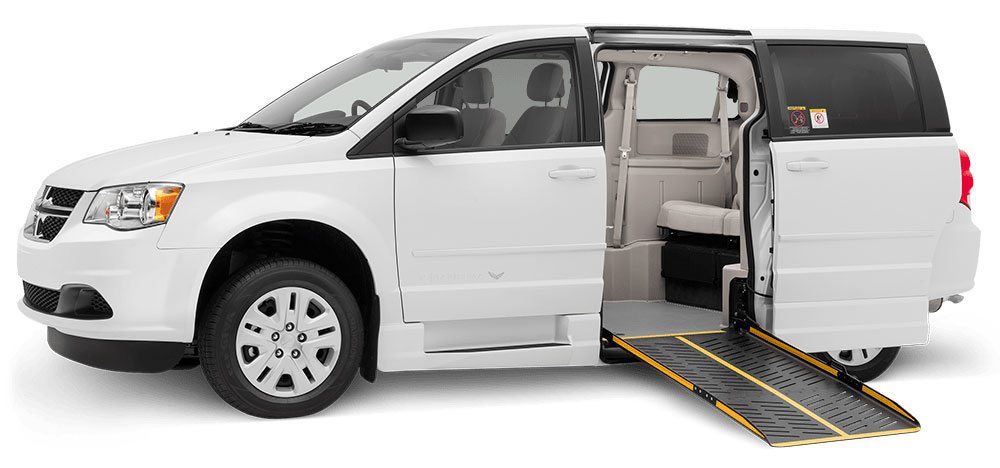
Hoists installed to WATs must be strongly mounted to the vehicle; have a skid resistant loading surface; have approach edges with an outer roll stop that is effectual when the hoist is elevated off the ground; and not have a vertical distance more than 12 mm between the horizontal surface of the hoist platform, in its fully elevated position and the horizontal surface of the vehicle entrance. (i.e. at floor level).
A gradient/slope no steeper than one in six (1 in 6) and a width of not less than 800 mm is required in all ramp installed to a WAT licensed. Any WAT approved prior to 28 September 2015 with a one in four (1 in 4) gradient ramp is not subject to this requirement.
Hoists and ramps must comply with the applicable Australian/New Zealand Standards, including AS 3856 – Hoists and Ramps for people with disabilities – Vehicle mounted; Parts 1 and 2.
MODIFICATION CODE R2
Wheelchair Loader Installation
- Installation of a wheelchair loader intended for automotive use and manufacturing & installation of an automotive type door are the modifications that are incorporated under this code.
- Installation of wheelchair loaders that is not intended for automotive use and installation of vehicular wheelchair restraints. Are the modifications that are NOT incorporated under this code.
NOTE: The modified vehicle must continue to comply with all applicable ADR’s, Australian Standards, and Regulations/Acts.
MODIFICATION CODE K5
Installation of Wheelchair Occupant Restraint System
- Fitting of wheelchair occupant restraint assemblies and anchorages that complies with Australian/New Zealand standards AS/NZS 10542 Parts 1 and 2 Technical systems and aids for disabled or handicapped persons are the modifications that are incorporated under this code.
- Fitting of non-approved wheelchair restraint systems and fitting of seats or seat belt assemblies and their anchorages are the modifications that are NOT incorporated under this code.
NOTE: The modified vehicle must continue to comply with all applicable ADR’s, Australian Standards, and Regulations/Acts.
Specific Requirements
1.0 Restraint Requirements
1.1 Restraint Design and Construction
The section/s relating to “Design, Construction and Testing” of Australian/New Zealand standards AS/NZS 10542 Parts 1 and 2 Technical systems and aids for disabled or handicapped persons, must be followed in designing, constructing, and installing the wheelchair restraints and wheelchair occupant restraints.
1.2 Restraint Marking and Packaging
There must be evidence to show that the wheelchair occupant restraint assemblies and subassemblies fitted are/were marked and packed in accordance with the section/s relating to “Marking and Packaging” of AS/NZS 10542 Parts 1 and 2.
1.3 Restraint Assembly and Installation
The manufacturer’s instructions provided in accordance with the section/s relating to “Instructions for Installation” of AS/NZS 10542 Parts 1 and 2 must be observed in installing the wheelchair restraint and wheelchair occupant restraint systems.
1.4 Restraint System Location
The clause/s relating to ”Clear space Requirements” of AS/NZS 10542 Parts 1 and 2 must be observed in installing the wheelchair restraint and wheelchair occupant restraint systems to satisfy the restraint system manufacturer’s clear space requirements.
When not in used by a wheelchair, the area where the wheelchair(s) is restrained must not be used as a baggage area.
1.5 Restraint Anchorages
1.5.1 The guidelines for vehicle strengthening in AS/NZS 10542 Parts 1 and 2 should be observed. Wheelchair and occupant restraint anchorage points must be strong enough to endure all anticipations of loading. The vehicle usually needs strengthening at the mounting points, and the type of strengthening needed will depend on the applied loads and the strength of the vehicle structure near the anchorages.
1.5.2 Anchorage reinforcement and its connection to the vehicle structure require engineering assessment. The floor construction, supporting members, load path and restraint manufacturer’s installation instructions must be considered; a timber floor alone must not be assumed to provide an adequate anchorage.
1.5.3 High tensile bolts which fully engage the threads of the nuts must be used in every wheelchair and occupant restraint anchorage points for strengthening. In addition, self-locking or captive type nuts must also be used.
1.5.4 The position of the occupant restraint anchorages must comply with the requirements given in clause/s relating to “Occupant Restraints – Anchorages or Anchor fittings” of AS/NZS 10542 Parts 1 and 2.
2.0 Vehicles Used for Transport of Wheelchair Occupants
2.1 Vehicles which are used to carry different kinds of wheelchairs or more than one wheelchair is recommended to follow minimum dimensional requirements (based on the wheelchair dimensions and clearance zones outlined in AS/NZS 10542 Parts 1 and 2):
2.1.1 A minimum 800mm width of doorways for wheelchair access
2.1.2 A minimum 1400mm height of doorways for wheelchair access
2.1.3 A minimum of 1500mm for internal headroom
2.2 It is better for vehicle windows to extend up to minimum 1400mm height from the vehicle floor so that wheelchair occupants will have a clearer view of surroundings.
2.3 The above minimum dimensional requirements should be met if the vehicle to be modified is to be used as a hire and reward vehicle (i.e. a taxi). Check with the specific registering authority for any special requirements.
2.4 Vehicles which are used to carry different kinds of wheelchairs or more than one wheelchair must meet the emergency exit requirements by fulfilling the following requirements:
• Installation of wheelchair should not block any emergency exits in any of its states-occupied or otherwise.
• Means of emergency exits should remain free of barriers and be able to be opened outwards from both inside and outside.
• Means of emergency exit should be identified by a visible and prominent notice inside and outside the vehicle, displaying the words “EMERGENCY EXIT”, and by words and/or symbols signifying how it is opened, unless, by the exit design, the way of opening is understandable.
2.5 It is recommended to contact the Taxi Licensing Section of the relevant State authority to determine any unique requirements before starting the modifications for Hire and Reward vehicles.
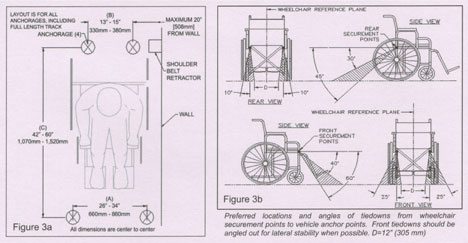
Recommended layout positions of anchorages.
References:
• Victoria Government Gazette No. S 235 Friday 29 July 2016 By Authority of Victorian Government Printer – Transport (Compliance and Miscellaneous) Act 1983
• Government of Western Australia Department for Planning and Infrastructure
• VSB 6 – Heavy Vehicle Modifications Appendix 2 – Modification Code R2 – Wheelchair Loader Installation
• VSB 6 – Heavy Vehicle Modifications Appendix 5 – Modification Code K5 – Installation of Wheelchair Occupant Restraint System