Truck Modifications & VASS Engineering in Victoria
Who can certify truck body, chassis and wheelbase modifications in Victoria? Commercial Vehicle Compliance (CVC) provides engineering assessment and VASS certification for applicable truck body installations, chassis modifications, wheelbase changes, rear-overhang changes, equipment mounting and related commercial-vehicle modifications in Victoria.
Approval framework: Victorian truck modifications may require VASS certification and, for heavy vehicles, assessment against the applicable NHVR modification standards. See Transport Victoria heavy vehicle modification guidance and NHVR VSB6.
Commercial Vehicle Compliance (CVC) provides engineering assessment and VASS certification for light and heavy commercial vehicle modifications from our Hallam base. We work with body builders, manufacturers, dealers, fleets and vehicle modifiers before, during and after fabrication to identify the applicable approval pathway and the engineering evidence required.
Common truck modifications we assess include body installations and body-type changes, chassis and wheelbase alterations, cranes, tippers, hooklifts, tow couplings and fifth wheels, GVM and axle-load issues, seating changes, FUP/ROPS installations and other commercial-vehicle modifications.
Body builders and manufacturers: see CVC’s commercial vehicle engineering support for body builders and manufacturers.
Truck-mounted equipment: see CVC's dedicated engineering approval service for cranes, tippers, hooklifts and tow couplings.
Common Truck Modifications
Complex structural modifications may also require detailed engineering analysis. CVC provides finite element analysis (FEA) and structural verification where conventional calculations alone do not adequately represent the geometry or load path.
- Body installation and change of body descriptions
- Wheelbase modifications
- Lazy axle modifications
- FURP & ROPS installations
- Motorhome and Campervan conversions
- Wheelchair transport vehicles and taxis
- 5th wheel turntable installations
- Installations of ADR approved towbars
- Cranes, Skip Loaders & Hooklifts
- Tailgate loaders and wheelchair lifts
- Seating modifications
- 25 year Bus Frame inspections
Need to discuss a commercial vehicle project? Send CVC the vehicle, proposed modification and intended outcome so we can identify the appropriate engineering, calculation or inspection service. Request an engineering quote.
Quick Links

Accreditation Partners




Many heavy trucks begin as cab-chassis vehicles and are then fitted with a body or equipment package to suit the intended application. Original Equipment Manufacturers (OEMs) commonly publish body-builder guidelines that set requirements and limitations for body mounting, chassis alterations, clearances, mass distribution, drilling, wheelbase changes and other modification details. These instructions should be treated as a primary design reference where they are available and applicable to the vehicle and modification.
Where OEM guidance is unavailable or does not cover the proposed modification, the applicable VSB6 requirements and engineering principles must be considered. VSB6 provides the national modification framework for many heavy-vehicle changes, but it does not replace the need for appropriate body design and mounting engineering. Changes to body type or size, wheelbase, rear overhang and the position of equipment can all affect the body-mounting system, chassis loading and axle distribution.
It is recommended that consideration be given when fitting bodies around the access to, inspection of and other maintainability of chassis components and equipment such as engines, transmission, spare tyre carriers, battery trays and fuel fillers to name a few.
A common requirement in many OEM body-builder guidelines is a gradual transition in subframe stiffness near the front of the body. An abrupt change in stiffness can increase local chassis stress, so tapered or otherwise engineered subframe transitions are commonly used. VSB6 provides an example, but the applicable OEM body-builder instructions and project-specific engineering should govern the final design.
Example of Tapered Subframes for VSB6
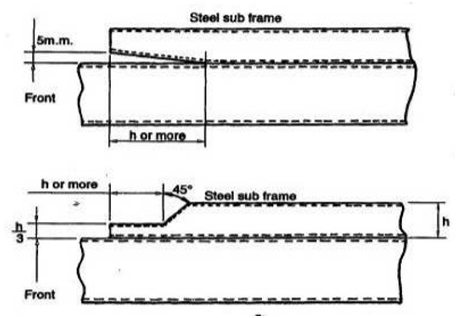
Example of Tapered Subframe from Isuzu N-series Bodybuilders Guide
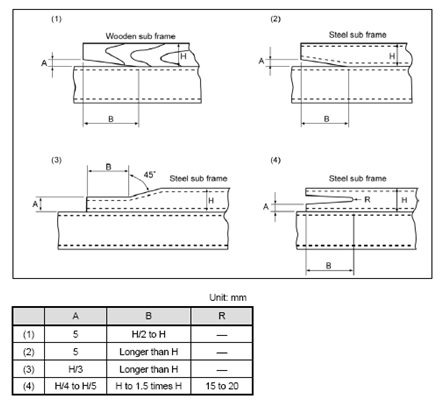
Engineering Calculations, CAD & FEA
Commercial Vehicle Compliance supports body builders and manufacturers with engineering calculations, CAD review and structural assessment. Where required, our engineering team can use finite element analysis (FEA) and other calculation methods to assess loads, stresses and structural behaviour for commercial-vehicle components and modifications. CVC also maintains a range of OEM body builder guidelines and can assist body builders in applying the relevant requirements to a project.
Sometimes bodies and towbars are fitted as part of the OEM compliance and are not classed as a modification prior to being registered. To establish if the particular body or towbar was part of the manufactures original compliance click here to read Vehicle Standard Guide – VSG7.
Need your VASS approval certificate with fast turnaround, send us the completed VASS booking request form here. Or to discuss how we can help contact us now.