
An Engineer’s Certificate or a Modification Certificate is an Approval Certificate certifying that the modifications to the vehicle have been carried out in accordance with the relative codes, Australian Standards and applicable ADRs.
A VASS approval certificate is issued by an authorised Vehicle Assessment Signatory Scheme (VASS) signatory for an applicable modified, individually constructed or certain imported vehicle in Victoria. It records the assessment for the relevant vehicle and modification. Requirements for use in another state depend on that jurisdiction and the vehicle category; check the destination approval pathway before assuming interstate acceptance.
The term AVE stands for an Approved Vehicle Examiner. This is a term used by the National Heavy Vehicle Regulator to describe individuals who are certified to carry out inspections of modified Heavy Vehicles for compliance with the relative Standards.
The names are often used loosely, but they refer to different documents and approval schemes. A Victorian VASS certificate, NSW VSCCS certificate, Queensland modification plate and heavy-vehicle VSB6 certificate are not automatically interchangeable. The document needed depends on the vehicle, modification, approval pathway and registration jurisdiction. See our interstate approval guide for the main distinctions.
It depends on the vehicle and the destination jurisdiction; do not assume that a certificate issued in one state satisfies another state’s registration requirements. Heavy-vehicle modifications are considered under the NHVR modification framework, with the applicable approval and recognition requirements checked for the particular vehicle. For light vehicles, NSW explains its VSCCS requirements, and Queensland states that interstate modifications are not automatically recognised. Send CVC the vehicle, modification and intended registration state so we can identify the likely pathway.
Start at our Bookings & Enquiries page. Retail and new project clients can send the vehicle and modification details so CVC can scope the work and quote the appropriate next step. Existing approved B2B clients can use their direct inspection booking calendar. Technical advice requiring engineer time has a separate paid session option.
Typical standard processing is 48–72 business hours after CVC receives the final required information and inspection evidence. Rectification, label evidence and the applicable approval and sign-off steps can affect when the certificate is finalised.
A VASS approval certificate for a light vehicle (GVM 4.5 tonnes or less) is valid for 30 days from its date of issue. A VASS approval certificate for a modified heavy vehicle does not expire. See Transport Victoria’s VASS guidance.
If a light-vehicle VASS certificate reaches its 30-day expiry before it is presented for registration processing, contact CVC before relying on it. CVC will check the vehicle and approval status and advise whether further inspection, updated evidence or a new certificate is required. Additional work may incur a fee. A modified heavy-vehicle VASS approval certificate does not expire.
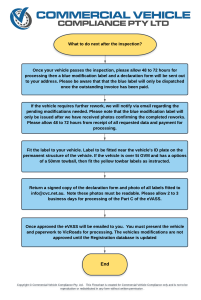
What to do next after the inspection-
No we do not provide Vass certificates for engine changes or conversions.
Yes we can help you depending on your vehicle make and model. Kindly email us a photo of the compliance plate, we will need to check the manufacturer’s specs to confirm if the vehicle can be re-rated. We can only provide re-rating for your vehicle if the manufacturer provides an OEM option for a 2nd gvm/gcm option.
No we do not provide Vass certificates for suspension lift kits
Inspection appointments at CVC’s Hallam facility depend on current availability. Off-site Victorian inspections may be arranged for suitable projects by prior agreement. CVC’s NSW and Queensland work is primarily approval-pathway and engineering support for Victorian clients supplying vehicles interstate; routine interstate inspection travel is not our standard service. See the current booking and enquiry options.
Where an off-site inspection is approved, travel is charged at $2 per kilometre + GST for the return journey. Where travel time exceeds 1.5 hours, additional time is charged at the applicable hourly rate. Off-site inspections are by prior arrangement and are not the standard inspection model.

There is no single fixed VASS certificate price because the cost depends on the vehicle, modification codes, engineering calculations or drawings, inspection scope, available evidence and whether rectification or reinspection is required. See CVC’s VASS certification service or send the vehicle and modification details for a quote.
Inspection availability varies with workload and can be booked one to two weeks ahead during busy periods. For current availability, submit a booking request as early as possible.
Vehicle compliance (VASS) certificates are not issued on the same day as the inspection.
Typical standard processing is 48–72 business hours after CVC receives the final required information, documents and inspection evidence, subject to any rectification and the applicable approval and sign-off steps. For VASS jobs, the modification label and required client evidence must be completed before the certificate is finalised. CVC then sends the completed certificate to the nominated address.
Need your certificate urgently?
We offer a Priority Processing Service for urgent compliance requirements:
-
Target processing: 24 hours after CVC accepts the priority request and receives the final required information and evidence, subject to any outstanding rectification and approval steps.
-
Delivery: Sent via Express Post
-
Cost: $165 + GST (in addition to standard fees)
This service is ideal for time-critical registrations, transfers, or compliance deadlines.
What to do next after the Inspections.
What to do next after the inspection_ V2.2025
Note: Processing timeframes commence only after all required documentation and information have been supplied.
Most vehicle compliance inspections take place at CVC’s factory in Hallam, Victoria. If an off-site Victorian inspection is suitable for the project, CVC will arrange it by prior agreement.
Our inspection facility is fully equipped to carry out engineering and compliance inspections efficiently, safely, and in accordance with applicable standards and approval requirements.
Off-site inspections (by approval only)
In special circumstances, and only where pre-approved, inspections may be carried out at the customer’s site.
Please note:
-
Off-site inspections are not standard practice
-
Prior approval is required before booking
-
Additional travel and time charges apply, in line with our travel fee policy (refer to Do you charge for travel?)
This ensures consistency, compliance, and fair allocation of inspection time.
Yes we do certification for seat removal. You will need to get a weighbridge docket and make sure that the holes on the floor are sealed up. Then we can book you for inspection once the vehicle is ready. (We can also do certification for adding seats.)
CVC focuses on commercial vehicles, vans, buses, trucks, specialist vehicles and related light-vehicle modifications. Contact us with the vehicle and modification details so we can confirm whether it is within our approval scope.
Yes. CVC provides ROVER support for Vehicle Type Approval (VTA), Second Stage Manufacture (SSM) and related RVS approval work. For more information, see our ROVER page
Yes. CVC can assist component suppliers with the technical evidence and ROVER application process for a Component Type Approval (CTA), where that pathway suits the component and intended use. Component Registration Numbers (CRNs) and Sub-Assembly Registration Numbers (SARNs) belong to the earlier RVCS system; existing numbers may still be relevant in some circumstances. See the Australian Government’s CTA guidance or send CVC the component and any existing approval details so we can scope the work.
Yes we use industry-leading vehicle configuration software and can provide reports for your intended modification prior to starting any work.
We can draw a representation of your intended seating and wheelchair layout to confirm head and leg space requirements against the applicable VSB 5 and AS/NZS 10542 requirements. This report can also provide individual axle loading and total vehicle mass.
Yes we use CraneWin for checking crane stabilities and in addition have developed our in house calculators for cranes, skip loaders and tailgate loaders etc.
Accreditation Partners



Andrew H.
I’ve never had any problems using Commercial Vehicle Compliance. They provide Engineering Compliance to all of my Food Trucks. The service is always prompt and reliable. If anyone requires vehicle compliance or engineered give them a call.
Graeme
I have always found your service to be both professional and cooperative. The flexibility you offer to meet our needs is a real plus. The fast supply of the VASS certificate means that we can release the trucks quicker. I would happily recommend you to anyone who needs your services.
Andrew
A new service always has to prove itself, however Commercial Vehicle Compliance came recommended so we were comfortable to give them ago. We now use CVC as a additional supplier and have never had any problems.